Wildlife
The Day the Birds Missed the Caterpillars
Spring is a schedule. When the schedule slips, a nest can fail without a storm
A bird does not need a theory of climate. It needs the caterpillars to be there when the mouths open.
Temperate forests run on a calendar that does not hang on a kitchen wall. Leaves open. Insects hatch into a salad of new tissue. Migrants, some of them flying from another hemisphere, arrive to harvest that pulse and turn it into nestlings. The whole trick is coincidence.
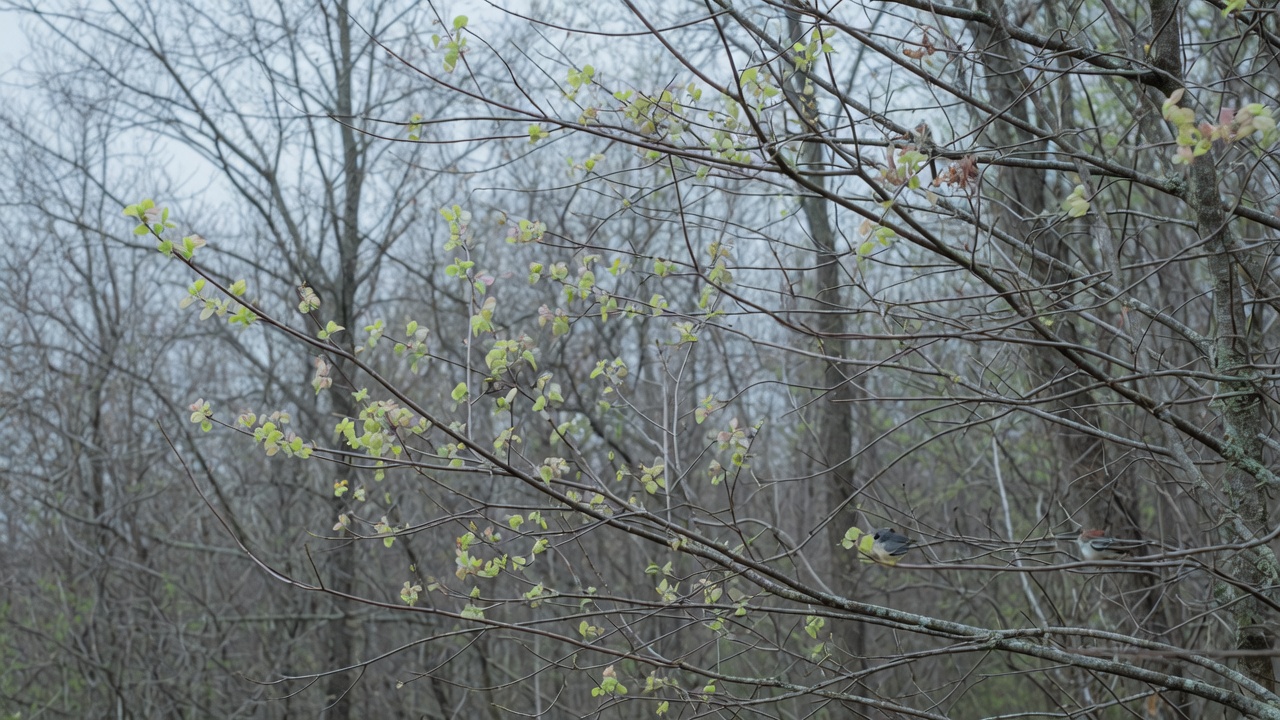
Warmth in spring can advance leaf-out and the insects that follow. A bird that times departure by day length, or by conditions far from the breeding ground, may land in a wood whose buffet has already peaked. The trees look fine. The adults may even look fine. The shortage is in a nest cup, in a week no one photographed.
Ecologists call this phenological mismatch. It is not a metaphor. It has been measured in multiple systems, most famously in some European songbirds and their caterpillar prey, and it is now a standard question wherever springs are moving. Established: the mechanism, and that it happens. Still open: how often it is the main reason a population falls, and how much a species can adjust. A green forest can still be, for a week that mattered, empty.
Nature’s calendar, without the kitchen wall
Phenology is the study of recurring life-cycle events: first leaf, first flower, insect emergence, arrival, laying, fledging. Farmers and naturalists kept such notes for centuries because the dates were useful. They have become a climate instrument because the dates are moving.
The chain in a Dutch oak wood is short enough to hold in one sentence. Spring warmth speeds the development of winter-moth eggs. The caterpillars (Operophtera brumata) need to hatch when oak buds open, or they starve or eat older, tougher leaves. Great tits (Parus major) and pied flycatchers (Ficedula hypoleuca) need those caterpillars in the days when nestlings grow fastest. Each link has its own cue. The oak responds to temperature, photoperiod, and winter chilling. The moth’s eggs accumulate warmth. The resident tit can start laying after a local spring that it has already felt. The flycatcher, wintering in West Africa, must decide to come north before it has sampled the Dutch leaves.
When the links shift at different rates, coincidence fails. That failure is the subject. It is easy to dramatize and easy to over-claim. Flying River will do neither. The Dutch work is the yardstick because it is long, because the food peak was measured rather than assumed, and because the researchers were willing to say when the birds had caught up and when they had not.
Oaks, winter moths, and a spring that changed shape
Marcel Visser and Lianne Holleman showed, in 2001, that warmer springs had disrupted the synchrony of oak budburst and winter-moth hatch in the Netherlands. The trouble was not only a higher average temperature. It was a change in pattern: spring warmth increased without a matching decline in winter frost. Eggs hatched before leaves were available. Caterpillars that emerge into a bare canopy do poorly; trees that leaf out into a waiting army of larvae also pay. The paper’s warning was methodological as well as ecological. Mean temperature is a blunt instrument. The sequence of warm and cold spells is what the organisms actually integrate.
That plant–insect mismatch is the first gear. The bird is the second. Visser and colleagues had already reported, in 1998, that great tits at the Hoge Veluwe were not advancing their laying dates even as the environment changed around them. Later analyses of the same population, and of related European studies, made the picture more precise and less linear. Laying date in great tits does respond to spring temperature, but the window of warmth the birds use as a cue is not identical to the window that sets the caterpillar peak. Climate change can therefore alter the relationship between the cue and the food, even if both still correlate with “spring.”
At Wytham Woods near Oxford, the long-studied great tit population advanced laying, in some decades faster than the caterpillars. At the Hoge Veluwe, for a time, the birds lagged. The contrast is the point. Phenological mismatch is not a single global date slipping. It is a local accounting of two or more schedules. A population with enough genetic variation, enough plasticity, or a broad enough diet may keep up. A population that does not will look, to a weekend walker, like a wood full of birds. The nest record will say otherwise.
Visser’s group has also shown that the pressure is not monotonic. In a 2021 analysis of the Hoge Veluwe great tits, they found that selection for earlier laying, which had strengthened as late-spring warming advanced the caterpillar peak, later weakened as the rise in those temperatures slowed. The food peak stopped advancing. The birds continued, somewhat, to lay earlier. The mismatch eased. The relationships among temperature, prey phenology, predator phenology, and selection held. The climate, over two decades, did not move in a straight line. That is not a consolation prize. It is a reminder that a mechanism can be established while a particular decade’s verdict remains open.
The flycatcher that could not leave Africa sooner
Pied flycatchers winter south of the Sahara and breed in European woods, often in the same nest-box plots as great tits. They are, in Christiaan Both and Marcel Visser’s phrase, constrained by arrival date. In a 2001 Nature paper the two showed that Dutch flycatchers had advanced laying over twenty years, but not enough: selection for earlier breeding had increased, and spring arrival had not advanced. Long-distance migrants often time the start of spring migration with endogenous rhythms and photoperiod—day length at the wintering ground—which climate change does not rewrite. The forest at the destination can leaf out earlier. The cue to leave Senegal does not automatically follow.
In 2006, Both, Sandra Bouwhuis, Kate Lessells, and Visser asked what that mistiming did to numbers. Comparing nine Dutch populations, they found that flycatchers had declined by about ninety percent over two decades in areas where the caterpillar peak fell early, and by about ten percent where the peak still fell late. They used the frequency of great-tit second broods as an independent marker of a late food season, because tits attempt second broods only when caterpillars persist. Habitat quality, measured as caterpillar biomass, was if anything higher in the early-peak woods. Resident great tits in the same boxes did not show the same relationship to peak date. The decline tracked the calendar, not a general rotting of the forest.
That result is as close as this literature comes to a population-level verdict, and it is still a verdict about particular Dutch woods, particular decades, and a species that must arrive before it can lay. Both later noted that declines were most apparent in rich deciduous forest, where the food peak is sharp, and less so in mixed and coniferous stands, where the peak is later and broader. A flycatcher that has always bred on the downhill side of a brief oak pulse has little slack. A flycatcher in a pine wood with a messier insect season has more.
The mechanism is established. The extrapolation to every declining migrant is not. Some species have advanced passage. Some have shortened stops. Some have shifted range. Some eat aphids when caterpillars are gone. Plasticity is a real biological property, not a press-release synonym for hope. It varies.
Photoperiod, and the information a migrant does not have
A resident bird lives inside the spring it must use. It can delay or accelerate laying by days in response to temperature, food, and social cues. A trans-Saharan migrant lives, for the decisive weeks, inside a different season. Eberhard Gwinner’s work on circannual rhythms showed that migratory readiness can be generated internally and calibrated by day length. Photoperiod at 10°N in March is not a thermometer for the Veluwe. If the Sahel and north-western Europe warm at different rates, or if the bird’s departure is gated by moult and fuel, the breeding ground can change faster than the bird’s schedule.
This is why mismatch is expected to hit long-distance migrants harder than residents, on average, and why the average conceals failures and successes. Great tits are not immune; they were the original mismatch example in some Dutch plots. They are, however, in the weather. Flycatchers are in a photoperiod. Swallows, flycatchers, warblers, and other Afro-Palearctic migrants have been the focus of a large subsequent literature testing whether arrival has kept pace with spring. Some populations have; many have not fully. Nicola Saino and colleagues, among others, have linked failure to advance arrival with declining trends in some European migrants. The pattern is suggestive and not universal. Flying River will not turn a well-replicated Dutch story into a claim that climate mismatch is the main cause of every songbird decline. Habitat loss on wintering grounds, hunting, pesticides, and fragmentation remain in the frame. Mismatch is a demonstrated way for a bird to fail in a forest that still photographs as intact.
The American parallel is real and less neatly boxed. Neotropical migrants arriving in eastern forests face a similar geometry: a wintering ground in the tropics or subtropics, a photoperiodic or endogenous departure, and a temperate pulse of Lepidoptera larvae after budburst. The data are more scattered across species and sites. The question is the same. Did the caterpillars peak in the week the mouths opened?
How often is the miss the cause?
Honesty requires a pause here. Demonstrating that laying is late relative to a food peak is not the same as demonstrating that a species is declining for that reason. Both’s 2006 comparison is unusually strong because it has a spatial contrast: early-peak woods versus late-peak woods, same country, same species, different fates. Many other studies have a time series of laying dates and a suspicion about insects. Some have both dates and food. Few have the counterfactual.
Great tits, again, complicate the sermon. They have declined in some regions and not in others. They have advanced in some decades and lagged in others. They can switch prey. Nestling diets are not one hundred percent winter moth. Selection can favour earlier birds without the population collapsing, if enough early genotypes exist or if immigrants arrive. Evolutionary rescue is a possible ending; so is a quiet thinning that never makes a headline.
There is also the opposite error: treating a green April as proof that the system is fine. A forest can leaf out, fill with adult birds, and still fail to fledge a normal cohort because the overlap of nestlings and larvae lasted five days instead of fifteen. The failure mode is a week. Our attention span is a season. Citizen science that records firsts—first swallow, first oak leaf—will catch the shift in the start of spring. It will not, by itself, catch the mismatch unless someone is also recording the peak of larvae and the hatch of chicks. The Dutch success was the pairing of those records, year after year, in the same plots.
Notebooks that make a week visible
The United States National Phenology Network, through Nature’s Notebook, organizes observers to record standardised life-cycle events in plants and animals across the country. The network exists because no laboratory can watch a continent’s spring. Its database has been used in scores of papers on the timing of leaf-out, bloom, and animal activity, and on the climatic drivers of those timings. It will not, on its own, tell you whether a wood thrush missed the inchworms. It will tell you whether the forest’s calendar is moving, and in which direction, at a scale that a single field station cannot reach.
In the United Kingdom, the Woodland Trust’s Nature’s Calendar is the public heir to a phenological tradition that includes records back to the eighteenth century. The modern scheme, running as a mass volunteer project since 2000, holds millions of observations of leafing, flowering, insect appearance, and bird arrival. Researchers use it to track how weather and a warming climate move the seasons, and to ask, in some papers, whether those shifts threaten the alignment of food webs. A first-cuckoo date is not a caterpillar curve. It is a data point that, stacked across counties and decades, becomes a map of a changing year.
These programs are easy to patronise as hobbies. They are closer to instrumentation. The Dutch mismatch would be a local curiosity without long nest-box records and caterpillar counts. The next mismatch, in a suburban wood or a national forest, will be invisible unless someone is looking on the right Tuesday. Phenology is unglamorous in the way that tide gauges are unglamorous. It is how a hidden calendar becomes public.
A failure that does not look like weather
We notice storms, oil, glass. We are slower to notice a food peak that occurred while a bird was still over the sea. Follow the connection far enough and “climate” is not only heat. It is the alignment of clocks that were never designed to be reset independently.
The clocks will not be reset by a nest box, and a nest box is not nothing. Keeping insect-rich habitat—oak understories that are not sprayed, hedgerows, dead wood, a messy edge—does not advance a flycatcher’s departure from Africa. It can widen the food peak so that a late bird still finds larvae, or alternative prey, in the week it has. Corridors, treated in this magazine’s essay on migration as infrastructure, determine whether the bird arrives at all. Phenology determines whether arrival is on time. The two failures can occupy the same forest in the same year: a fragmented wood whose remaining oaks leafed out too soon.
The useful civic response is not a sermon about carbon delivered at the nest. Carbon is the large, slow lever on the temperature that sets the hatch. The local levers are the records and the habitat. Support the unglamorous notebooks. Leave enough insects that a late arrival is not also a starved one. Read a quiet spring as a timing question, not only a counting question.
A bird does not need a theory of climate. It needs the caterpillars to be there when the mouths open. The theory is for us: so that we do not mistake a green week for a full one, and so that we know which clock we are looking at when the mouths close on air.
Sources
- Visser, Marcel E., A. J. van Noordwijk, J. M. Tinbergen, and C. M. Lessells. “Warmer Springs Lead to Mistimed Reproduction in Great Tits (Parus major).” Proceedings of the Royal Society B 265 (1998): 1867–1870.
- Visser, Marcel E., and Lianne J. M. Holleman. “Warmer Springs Disrupt the Synchrony of Oak and Winter Moth Phenology.” Proceedings of the Royal Society B 268, no. 1464 (2001): 289–294.
- Both, Christiaan, and Marcel E. Visser. “Adjustment to Climate Change Is Constrained by Arrival Date in a Long-Distance Migrant Bird.” Nature 411 (2001): 296–298.
- Both, Christiaan, Sandra Bouwhuis, C. M. Lessells, and Marcel E. Visser. “Climate Change and Population Declines in a Long-Distance Migratory Bird.” Nature 441 (2006): 81–83.
- Visser, Marcel E., and Christiaan Both. “Shifts in Phenology Due to Global Climate Change: The Need for a Yardstick.” Proceedings of the Royal Society B 272 (2005): 2561–2569.
- Visser, Marcel E., et al. “Shifts in Caterpillar Biomass Phenology Due to Climate Change and Its Impact on the Breeding Biology of an Insectivorous Bird.” Oecologia (2006) and related Hoge Veluwe time series.
- Visser, Marcel E., et al. “Recent Natural Variability in Global Warming Weakened Phenological Mismatch and Selection on Seasonal Timing in Great Tits (Parus major).” Proceedings of the Royal Society B (2021).
- Cresswell, Will, and Robin McCleery. Analyses of Wytham Woods great tit laying dates relative to food phenology (Journal of Animal Ecology, 2003).
- Gwinner, Eberhard. Work on circannual rhythms, photoperiod, and migratory timing in birds (Ibis, Journal of Biological Rhythms, and related papers).
- Saino, Nicola, et al. “Climate Warming, Ecological Mismatch at Arrival and Population Decline in Migratory Birds.” Proceedings of the Royal Society B 278 (2011): 835–842.
- USA National Phenology Network. Nature’s Notebook and the National Phenology Database; usanpn.org.
- Woodland Trust. Nature’s Calendar; naturescalendar.woodlandtrust.org.uk. Volunteer phenology records for the United Kingdom, including historical series.
- Sparks, Tim H., and related analyses using Nature’s Calendar and other European phenological datasets.
A bird does not need a theory of climate. It needs the caterpillars to be there when the mouths open.
Follow the connection
- Warming spring
- Earlier leaves
- Earlier insects
- Migrant arrival
- Missed peak
- Fewer young
What we know
- Many species time breeding and migration to pulses of food that last days or weeks.
- Warming has shifted the timing of leaf-out and insect emergence in numerous temperate systems.
- Long-distance migrants often cannot fully track those shifts, producing a mismatch documented in multiple bird–insect relationships.
- The failure can look like an ordinary bad year at a single nest.
What remains uncertain
- How much plasticity a given population has—whether it can shift dates or switch prey.
- Which mismatches are already reducing populations, versus remaining a local inconvenience.
- How habitat fragments and light at night compound the calendar problem.
What can we do?
You don't have to care about this because everyone else does. You can care because the evidence gives you a reason to.
- Treat a “quiet spring” as a timing question, not only a counting question.
- Support long-term phenology records (the unglamorous notebooks that make mismatch visible).
- Keep corridors and insect-rich habitat so a late bird still has something to eat.
Demonstration authors are fictional. The phenomena discussed are real subjects of public scientific literature and reporting. Sources named in the article are documented; this is not a comprehensive literature review.