Environment
The Straw Is Not the Story
What we know—and don't know—about plastic straws and marine life
A photograph of a straw and a sea turtle can move a million people by lunchtime. That is not nothing. Attention is a scarce resource, and suffering is easier to grasp when it has a face and a prop.
In August 2015, the marine biologist Christine Figgener and colleagues, working from a small boat off the Pacific coast of Costa Rica, found a male olive ridley sea turtle with something lodged in a nostril. At first they took it for a parasite. It was a plastic drinking straw, ten to twelve centimetres long, crusted and driven deep into the nasal passage. They pulled it out with pliers from a Swiss Army knife. The animal bled. The video Figgener posted was graphic, and it travelled. Starbucks, cities, airlines, and national governments announced straw restrictions. The object on the table became the object in the news.
A good symbol can still be a bad map.
Plastic in the ocean is real. Ingestion is real. Entanglement is real. Fragmentation into smaller pieces is real. What does not follow is that the product most suited to a campaign is the product doing most of the work. The straw is a particular shape, easy to refuse at a counter, easy to photograph in an animal. The waste stream that actually loads the water is heavier, more industrial, and less photogenic. If we treat the mascot as the inventory, we will keep congratulating ourselves for a completed policy while the nets, the films, the fragments, and the places without collection continue.
This is not an argument for keeping a product that has no particular claim on existence. It is an argument against letting a small, visible item stand in for a system.
What the mass actually is
In 2015, Jenna Jambeck and colleagues published, in Science, the first widely cited estimate of how much land-based plastic waste reaches the ocean. They linked solid-waste data, population density, and economic status for 192 coastal countries. For 2010 they calculated that those countries generated about 275 million metric tons of plastic waste, and that 4.8 to 12.7 million metric tons of it entered the ocean. The midpoint of that range—about eight million metric tons—became a public number. It is a model, not a weigh-in at a dock. The authors were explicit that the flux depends on how much waste is mismanaged near coasts, and that without better collection the cumulative mass available to leak would rise sharply.
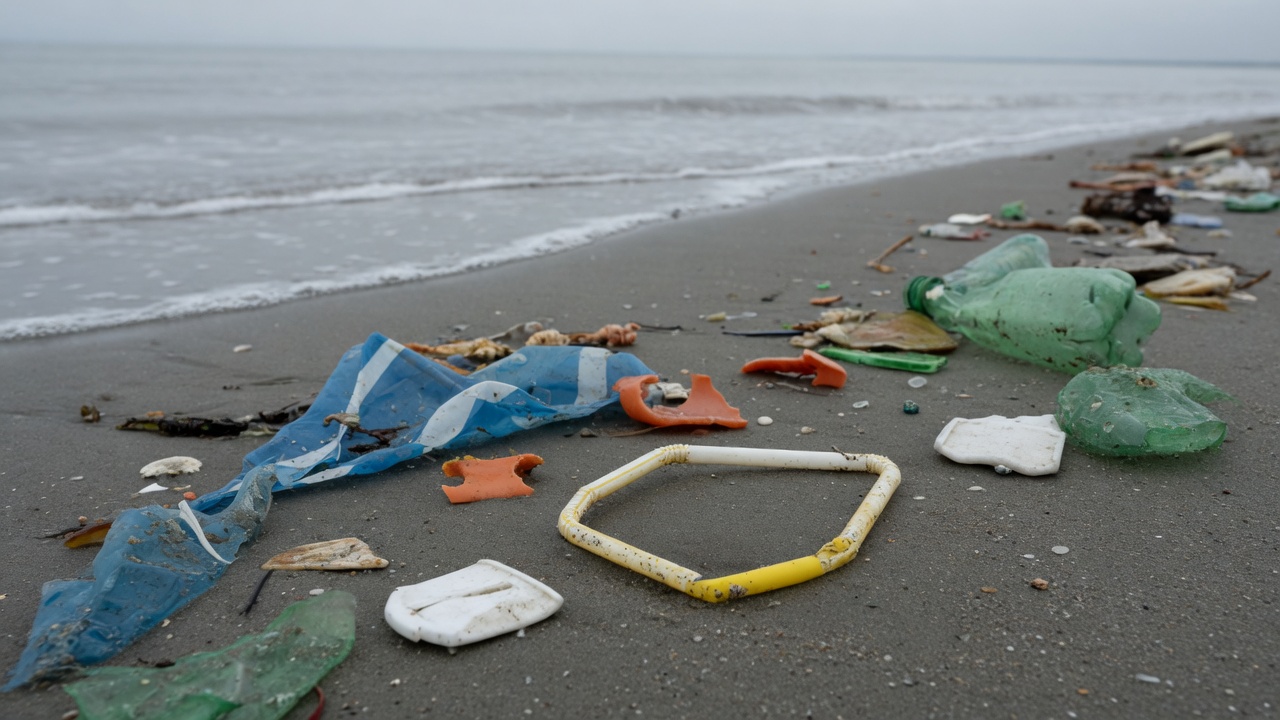
Eight million metric tons is a quantity that does not look like a straw. It looks like uncollected packaging, bottles, film, and fragments moving from streets and dumps into rivers and surf. Laurent Lebreton and colleagues later estimated, in Nature Communications, that rivers alone deliver on the order of 1.15 to 2.41 million tonnes of plastic to the sea each year, with a large share of that flux concentrated in a relatively small number of catchments. Those two papers do not describe the same object in the same year with the same method. They agree on a direction: land-based leakage is large, geographically uneven, and governed more by waste systems than by any one consumer product.
Then there is the patch that is not a patch. In 2018, Lebreton and co-authors, writing in Scientific Reports, characterised the Great Pacific Garbage Patch—the accumulation zone in subtropical waters between California and Hawaii. Their model, calibrated with multi-vessel and aircraft surveys, put at least 79 thousand tonnes of floating plastic (with a range of 45 to 129 thousand) inside an area of about 1.6 million square kilometres, several times earlier estimates, because they counted large debris more carefully. Over three-quarters of that mass was in pieces larger than five centimetres. At least 46 percent of the mass was fishing nets. Microplastics accounted for about 8 percent of the mass and about 94 percent of the estimated 1.8 trillion pieces. The gyre is not a soup of straws. It is, by weight, a graveyard of gear designed to survive at sea.
That finding does not license the old slogan that “80 percent of marine debris is land-based and 20 percent is from ships,” a ratio that has been repeated more often than it has been measured for any particular basin. Lebreton himself noted that the fishing-gear share in the North Pacific accumulation zone was higher than the team had expected. The honest statement is narrower and more useful: in this pelagic patch, by mass, abandoned nets dominate. Nearshore surveys, river mouths, and city beaches tell different stories. A map that is true in one place is not a map of the whole ocean.
Count is not mass
Every September, volunteers in the Ocean Conservancy’s International Coastal Cleanup walk beaches and waterways and tally what they pick up. Over decades, the same consumer items recur near the top of the list: cigarette filters, food wrappers, bottles, bags, caps, and, regularly, straws and stirrers. In cumulative tallies spanning 1986 through the early 2020s, straws and stirrers sit in the top ten items by count. That is a real observation about what is abundant, small, and easy to pick up on a shoreline.
It is not a mass budget. A straw weighs a fraction of a gram. A discarded net can weigh tonnes. Cleanup protocols that score pieces will always over-represent light, numerous objects relative to heavy, fewer ones. Fragments of unidentified plastic, which are often the largest category once you look closely, further scramble any attempt to treat a branded product as the unit of harm. The Conservancy’s own data are a census of what volunteers encounter, not a weighing of the ocean.
The distinction is not pedantry. Policy that follows count will chase items that photograph well. Policy that follows mass and mechanism will chase fishing gear in some waters, river leakage in others, and packaging films that move like sails. You can do more than one of those things. You cannot pretend they are the same thing.
How many straws on a shore
In 2017, Britta Denise Hardesty, Chris Wilcox, and colleagues at CSIRO produced a report for Ocean Conservancy and NOAA analysing U.S. shoreline debris. Combining International Coastal Cleanup records, NOAA monitoring, and CSIRO survey methods, they estimated that at any given moment somewhere between 20 million and 1.8 billion debris items can be found on the shoreline of the continental United States—a range so wide it is itself a finding. Debris is deposited and washed off continuously. Densities vary with people, rivers, and the shape of the coast.
From related analyses of U.S. cleanup data, Hardesty and Wilcox were later cited—in an Associated Press report by Seth Borenstein in 2018—as estimating nearly 7.5 million plastic straws on American shorelines, and, by extrapolation, on the order of 437 million to 8.3 billion on coastlines worldwide. Those figures are order-of-magnitude illustrations built on cleanup samples, not a global inventory. The interval spanning hundreds of millions to billions should be read as a confession of uncertainty, not as a pair of precise endpoints. Shoreline counts miss what has already sunk, what is still inland, and what never left a dump. They also miss most of the mass.
Journalists then did a further piece of arithmetic. If all the straws used in a year went to sea, and if the ocean’s land-based plastic input is taken as Jambeck’s midpoint of about eight million metric tons, straws would be a few hundredths of a percent of that flux. Axios, in 2018, put the illustration at 0.03 percent. Bloomberg Opinion used the same comparison. The 0.03 percent figure is a back-of-envelope, not a measurement. It assumes a straw-production mass, assumes that mass reaches the water, and divides by a modelled ocean input. None of those steps is sacred. As an illustration it is useful: even a generous straw scenario is a thin slice of the mass problem. As a slogan it becomes a way to dismiss the whole subject. The first use is legitimate. The second is a different error from the campaign’s.
What actually kills, and how we know
Harm is not evenly distributed across objects. Some animals encounter floating debris as if it were food. Others encounter loops and nets as traps. A straw is a particular shape; a fragment is another; a ghost net is another still. Collapsing those differences into “plastic is bad” is understandable and imprecise in the same breath.
In 2016, Wilcox, Nicholas Mallos, George Leonard, Alba Rodriguez, and Hardesty published, in Marine Policy, an expert-elicitation study of how common shoreline litter items threaten seabirds, sea turtles, and marine mammals. They used decades of cleanup inventories as the menu of items, then asked specialists to score entanglement, ingestion, and chemical contamination. Fishing-related gear, balloons, and plastic bags ranked as the greatest entanglement risks. For ingestion, bags and plastic utensils ranked highest. Entanglement was judged slightly worse than ingestion because it is more often lethal. Straws and stirrers appeared on the list. They did not lead it.
Later work has been more particular still. Lauren Roman, Wilcox, Hardesty, and colleagues, examining necropsies of seabirds, found that balloons and other soft items were far more likely to kill per ingestion than hard plastic fragments, even though hard fragments were the majority of items in guts. Soft film and rubber obstruct. Hard chips often pass. The ranking is not a popularity contest among products. It is a statement about shape, flexibility, and the gut.
None of this makes a straw in a turtle’s nostril imaginary. Figgener’s animal was an individual, and individuals suffer. Evidence of harm at the level of individual animals is easier to document than evidence of population collapse caused by a specific consumer product. Those are different claims. Established: plastic debris injures and kills animals by ingestion and entanglement, and fishing gear is a dominant entanglement hazard. Probable: bags, films, and balloons punch above their count for certain taxa. Plausible but not demonstrated at scale: that removing straws from restaurants, by itself, changes the trajectory of any marine population. Unknown: the fraction of observed wildlife deaths that can be attributed to any one product line in any one basin.
The same caution applies to the old claim that marine plastic is “mostly straws and bottles from land.” It is not. It is mostly, in different places, different things.
Fragmentation, and the laboratory ocean
A straw that reaches water does not remain a straw. Ultraviolet light, heat, and mechanical wear embrittle polymers. Anthony Andrady, reviewing the process in Marine Pollution Bulletin in 2011, described how weathering on beaches produces surface cracking and microparticles that wind and waves then move. Degradation in air and on sand is faster than degradation of the same polymer floating in seawater, where cooler temperatures and biofouling slow photodegradation. The ocean does not digest plastic so much as it files it down. The file is light, salt, and time.
Microplastics—particles smaller than five millimetres, in the definition that has become conventional—are now found in seawater, sediment, ice, air, and animals. Richard Thompson and colleagues showed, in Science in 2004, that microscopic plastic was already widespread in marine sediments and in the water column around the British Isles. That presence is established. What the particles do to wild populations is not.
Laboratory studies have demonstrated ingestion, reduced feeding, inflammation, and, at high doses, mortality in a range of invertebrates and fish. Many of those experiments use concentrations, particle shapes, and polymer types that do not match field samples. Phuong and colleagues, among others, have pointed out the mismatch: the lab often offers one polymer, one size, in numbers orders of magnitude above what a mussel actually meets. GESAMP’s assessments have been careful on the same point. Impacts demonstrated in tanks are not automatically impacts in the sea. Trophic transfer has been shown under artificial diets; it has not been shown to accumulate through wild food webs in the way a persistent pesticide does. The chemical load that plastics can sorb from seawater, and the additives they can shed, remain active research. Bioavailability is not the same as presence.
Flying River will keep the levels apart. Established: fragmentation happens, microplastics are ubiquitous, animals ingest them. Probable: some species, in some places, incur costs to energy budgets or to individual health. Unknown: population-level harm from microplastic ingestion in the open ocean, at the concentrations that exist. That unknown is not a dismissal. It is the difference between a completed indictment and a research programme.
The person who still needs the straw
When cities and chains moved to ban or hide plastic straws, disability advocates said, quickly and in public, that a flexible plastic straw is not a cocktail accessory for everyone who uses one. People with limited grip, with dysphagia, with cerebral palsy, with a range of neuromuscular conditions, use straws to drink without aspiration, without a spill, without asking a stranger to tip a cup. Paper straws soften. Metal conducts heat and can injure. Glass breaks. Compostable plastics are not always stiff enough, or cheap enough, or available at a register. Requiring a customer to disclose a medical need at a counter is a different burden from keeping a box under the bar.
This is not a reason to put a straw in every iced coffee. It is a reason not to write a rule as if the only user were a person who could take or leave the object. Seattle’s ordinance, among others, included an exemption; advocates noted that an exemption that must be requested, and that restaurants may not stock, is a thinner protection than it sounds. The Americans with Disabilities Act requires places of public accommodation to provide auxiliary aids. Legal comments in the Iowa Law Review and the American University Law Review have argued that a rigid ban can collide with that duty. The collision is not a talking point against all waste reduction. It is a design constraint: reduce default distribution without pretending that “no straws anywhere” is a finished civic good.
A publication that follows objects after they leave our hands should also notice who still needs the object in hand.
The rest of the table
You can refuse a straw because it is an easy refusal. You can also look at the rest of the table: the film around the takeaway, the bottle, the cigarette filter, the balloon from the party, the fishing line that is not on the table at all.
If the question is mass in a subtropical gyre, the lever is gear: marking, retrieval, port reception, the economics of bringing a torn net home instead of cutting it away. Richardson, Hardesty, and Wilcox estimated, in a 2019 meta-analysis in Fish and Fisheries, that on the order of 6 percent of nets, 9 percent of traps, and 29 percent of lines are lost each year—rates, not tonnes, and with wide study-to-study ranges. A later interview-based paper by the same team revised some of those percentages downward. The 640,000-tonne figure for abandoned gear that still circulates in speeches is, they have written, a number that was never a robust global estimate. The direction remains: working fleets shed working plastic, and that plastic is built to last.
If the question is count on a city beach, the levers are storm drains, overflowing bins, and the products that dominate cleanups. If the question is leakage from land, the lever is collection in the places Jambeck’s model flagged—rapidly growing coastal cities where waste systems have not kept up with packaging. A straw ban in a city with curbside recycling and a sewer system is not the same intervention as a straw ban in a city where the dump sits on a river. Geography is not a footnote. It is the mechanism.
None of this requires a performance of purity. Carry a reusable bottle if you will. Ask for no straw if you do not need one. Support, if you have a vote or a budget, the unglamorous contracts: catchment booms, fishing-for-litter programmes, deposit-return for bottles, actual collection where there is none. Judge a policy by whether the right objects stop reaching water, not by whether the announcement felt like participation.
You don’t have to care about this because a video told you to. You can care because waste has a geography, and geographies can be redesigned—at a shop counter, in a municipal contract, on a working boat.
The straw was never the story. The story is everything that leaves our hands and does not stay where we left it, ranked by how it moves and what it does when it arrives. A symbol that moves a million people by lunchtime has done a kind of work. The next kind of work is to put the symbol down and look at the inventory.
Sources
- Jambeck, Jenna R., Roland Geyer, Chris Wilcox, Theodore R. Siegler, Miriam Perryman, Anthony Andrady, Ramani Narayan, and Kara Lavender Law. “Plastic Waste Inputs from Land into the Ocean.” Science 347, no. 6223 (2015): 768–771.
- Lebreton, Laurent C. M., Joost van der Zwet, Jan-Willem Damsteeg, Boyan Slat, Anthony Andrady, and Julia Reisser. “River Plastic Emissions to the World’s Oceans.” Nature Communications 8 (2017): 15611.
- Lebreton, L., B. Slat, F. Ferrari, B. Sainte-Rose, J. Aitken, R. Marthouse, S. Hajbane, et al. “Evidence That the Great Pacific Garbage Patch Is Rapidly Accumulating Plastic.” Scientific Reports 8 (2018): 4666.
- Ocean Conservancy. International Coastal Cleanup data and reports, including Charting a Course to Plastic-Free Beaches (2023) and subsequent ICC tallies of top items by count, 1986–2023.
- Hardesty, Britta Denise, Chris Wilcox, Qamar Schuyler, T. J. Lawson, and Kimberley Opie. Developing a Baseline Estimate of Amounts, Types, Sources and Distribution of Coastal Litter — An Analysis of US Marine Debris Data. Final report for Ocean Conservancy and NOAA, 23 October 2017.
- Borenstein, Seth. “Science Says: Amount of Straws, Plastic Pollution Is Huge.” Associated Press, 20 April 2018.
- “Plastic Straws Play Only Minor Role in Global Plastics Pollution.” Axios, 22 July 2018.
- Minter, Adam. “Plastic Straws Aren’t the Problem.” Bloomberg Opinion, 7 June 2018.
- Wilcox, Chris, Nicholas J. Mallos, George H. Leonard, Alba Rodriguez, and Britta Denise Hardesty. “Using Expert Elicitation to Estimate the Impacts of Plastic Pollution on Marine Wildlife.” Marine Policy 65 (2016): 107–114.
- Wilcox, Chris, Erik Van Sebille, and Britta Denise Hardesty. “Threat of Plastic Pollution to Seabirds Is Global, Pervasive, and Increasing.” Proceedings of the National Academy of Sciences 112, no. 38 (2015): 11899–11904.
- Roman, Lauren, Britta Denise Hardesty, Mark A. Hindell, and Chris Wilcox. “A Quantitative Analysis Linking Seabird Mortality and Marine Debris Ingestion.” Scientific Reports 9 (2019): 3202.
- Richardson, Kelsey, Britta Denise Hardesty, and Chris Wilcox. “Estimates of Fishing Gear Loss Rates at a Global Scale: A Literature Review and Meta-analysis.” Fish and Fisheries 20, no. 6 (2019): 1218–1231.
- Richardson, Kelsey, Chris Wilcox, Joanna Vince, and Britta Denise Hardesty. “Challenges and Misperceptions around Global Fishing Gear Loss Estimates.” Marine Policy 129 (2021): 104522.
- Andrady, Anthony L. “Microplastics in the Marine Environment.” Marine Pollution Bulletin 62, no. 8 (2011): 1596–1605.
- Thompson, Richard C., Ylva Olsen, Richard P. Mitchell, Anthony Davis, Steven J. Rowland, Anthony W. G. John, Daniel McGonigle, and Andrea E. Russell. “Lost at Sea: Where Is All the Plastic?” Science 304, no. 5672 (2004): 838.
- Phuong, Nam Ngoc, Aurore Zalouk-Vergnoux, Laurence Poirier, Andrea Kamari, Abderrahmane Châtel, Christophe Mouneyrac, and Fabienne Lagarde. “Is There Any Consistency between the Microplastics Found in the Field and Those Used in Laboratory Experiments?” Environmental Pollution 211 (2016): 111–123.
- GESAMP. Sources, Fate and Effects of Microplastics in the Marine Environment: A Global Assessment. Reports and Studies No. 90. London: IMO, 2015; and Part 2, Reports and Studies No. 93, 2016.
- Hitselberger, Karin. Commentary on straw access and disability, Washington Post, 2018; see also Willison, Karin, “Disposable Plastic Straws Suck,” The Mighty, 2018.
- Wong, Alice. “The Last Straw.” Eater, 19 July 2018.
- “Water, Water Everywhere, but Not a Straw to Drink: How the Americans with Disabilities Act Serves as a Limitation on Plastic Straw Bans.” Iowa Law Review 105 (2019): 369.
- Figgener, Christine, and Nathan J. Robinson. Field video and contemporaneous accounts of the 2015 olive ridley extraction, Costa Rica; reported in the Washington Post, 17 August 2015, and by Texas A&M University.
A good symbol can still be a bad map.
Follow the connection
- Product
- Litter
- Waterway
- Coast
- Fragmentation
What we know
- Plastic is abundant in marine environments.
- Animals can ingest plastic or become entangled in it.
- Larger items fragment into smaller pieces over time.
- Straws are one product among many; other items (nets, bags, fragments, packaging) often dominate debris surveys.
What remains uncertain
- The relative contribution of straws to harm, compared with fishing gear and other packaging, is easy to overstate in public debate.
- Effects of microplastic ingestion on wild populations are an active research area; laboratory results do not automatically scale to oceans.
- Waste pathways differ dramatically by country, drainage, and fishing practice.
What can we do?
You don't have to care about this because everyone else does. You can care because the evidence gives you a reason to.
- Reduce unnecessary single-use plastic without confusing a straw ban for a completed policy.
- Pay more attention to items that persist as gear or bulk packaging.
- Support waste systems that intercept material before rivers, not only beach cleanups after the fact.
- Keep asking which objects, in which places, actually enter the water.
Demonstration authors are fictional. The phenomena discussed are real subjects of public scientific literature and reporting. Sources named in the article are documented; this is not a comprehensive literature review.