Science
When the Wind Meets the Ocean
Offshore wind, whales, and the difficult science of unintended consequences
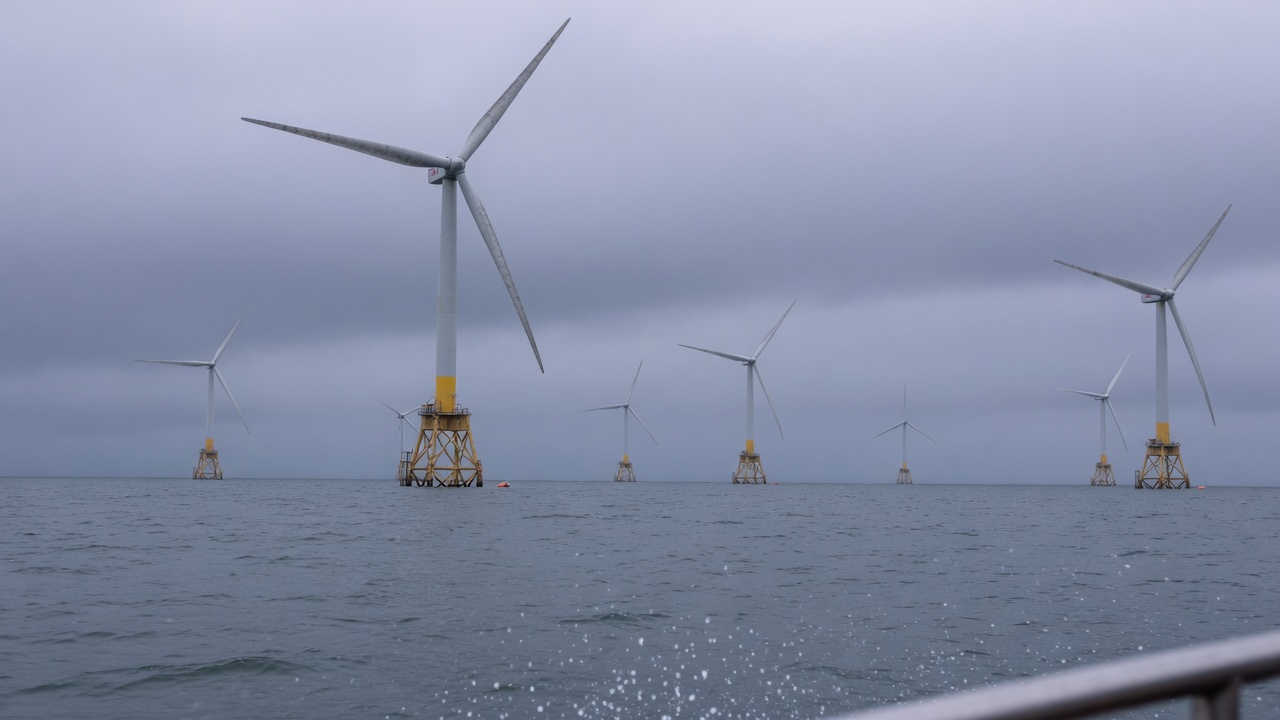
A coastline can hold two true statements at once. One is that the atmosphere is accumulating heat-trapping gases, that the ocean is taking up much of that heat, and that replacing some of the fuel burned for electricity with wind that does not emit carbon at the point of generation is, in climate terms, a serious intervention. The other is that the same intervention, placed in the water, is a construction project in a habitat that already contains endangered animals, shipping lanes, fishing gear, and a soundscape that was not empty before the first turbine was proposed.
A good intention does not eliminate the need to ask hard questions.
That sentence is the editorial premise of this piece. It is not a coded way of saying that offshore wind is a mistake. It is not a coded way of saying that opposition to offshore wind is a mistake. Flying River will not treat a climate technology as a sacrament, and it will not treat a whale stranding as a verdict on a lease. The work is to keep the climate benefit and the local ecological cost in the same frame, and to refuse the slogans that would delete either one.
What is actually in the water
An offshore wind project is not a single sound, and it is not a single season.
Before steel is driven, developers map the seabed. High-resolution geophysical surveys—multibeam echosounders, sidescan sonars, sub-bottom profilers, and, in some campaigns, boomers and sparkers—are used to image the upper tens of metres of sediment, to find hazards, and to route cables. These sources are not the airgun arrays used to hunt oil and gas kilometres down. Carolyn Ruppel, Thomas Weber, and colleagues, writing in 2022, sorted marine acoustic sources into tiers by source level, frequency, directionality, and duty cycle. Most high-resolution geophysical, oceanographic, and tracking sources fell into a de minimis category they judged unlikely to result in incidental take of marine mammals; large airgun arrays occupied the top tier. NOAA Fisheries has made the same distinction in public: the sounds from these site-characterization surveys are generally lower in level, higher in frequency, and narrower in beam than seismic airguns or tactical military sonar, and the area in which they might disturb a marine mammal is orders of magnitude smaller.
“Disturb” is a legal word. Under the Marine Mammal Protection Act, Level B harassment is a disruption of behavioral patterns—migration, breathing, nursing, breeding, feeding, sheltering—without injury. Developers have sought incidental harassment authorizations for that class of take. NOAA Fisheries has stated that it does not anticipate, and has not authorized, death or serious injury of whales for wind-related actions. That is a regulatory fact. It is not a biological proof that no animal will ever be harmed. It is the agency’s assessment of the sources as they are used.
Construction is a different acoustic object. Impact pile driving of monopiles—steel tubes several metres across, hammered into the shelf—produces impulsive, high-amplitude sound that propagates through water and through the seabed. Harbor porpoises in European waters have been shown to leave pile-driving sites; the displacement can last hours to days, and in some studies longer. U.S. authorizations for East Coast projects have treated the risk as large enough to require seasonal moratoria on foundation installation in the months when North Atlantic right whales are most likely to be present, typically a winter and early-spring window on the order of December or January through April, with December often restricted or allowed only with extra approval. They have required noise-abatement systems, commonly a double bubble curtain and sometimes a second technology, with a planning assumption of about 10 decibels of attenuation. They have required visual observers and passive acoustic monitoring, with delay or shutdown if a right whale is seen at any distance or detected on the hydrophones within specified zones.
Those measures exist because pile driving is loud, not because it has been shown to kill whales on the U.S. East Coast. Absence of documented mortality is not the same as absence of effect. Displacement from a feeding or calving area, lost foraging, and the added vessel traffic of a construction fleet are effects that do not require a carcass.
Operation is a third object. Jakob Tougaard, Line Hermannsen, and Peter Madsen reviewed available measurements of underwater noise from operating turbines in 2020. Source levels were at least 10–20 decibels lower than ship noise in the same low-frequency range. Distance to the turbine was the dominant predictor of received level; wind speed and turbine size mattered less in the data they had. A simple multi-turbine model suggested that cumulative noise could be elevated out to a few kilometres under very quiet ambient conditions, and would sit below ambient except close to the machines in a busy or windy sea. They warned that as farms grow in number and in turbine size, the cumulative contribution should be in the assessments. That is a call for accounting, not a finding of harm. Operational noise is real, generally modest relative to a passing ship, and not yet a completed story for the largest machines now being installed.
Vessels are a fourth object, and they are not unique to wind. Crew-transfer ships, cable-laying barges, survey vessels, and the ordinary traffic of a working port add hulls to water that already contains them. A ship can strike a whale whether it is servicing a turbine or carrying containers. A ship also adds continuous noise. If a project increases the number of hulls in a right-whale habitat, the relevant question is not whether wind is “quiet” in the abstract. It is whether the additional traffic, at the speeds actually used, measurably raises the risk that was already the leading documented cause of death.
Three unusual mortality events, and what they are not
Since January 2016, NOAA Fisheries has recorded elevated humpback whale mortalities along the Atlantic coast from Maine through Florida. The event was declared an Unusual Mortality Event in April 2017 and includes deaths from 2016 onward. NOAA’s running table, updated into 2026, has listed on the order of 260 confirmed mortalities in that UME. Partial or full necropsies have been conducted on about half. Of 129 whales examined as of a mid-2025 update, about 45 percent had evidence of human interaction—vessel strike or entanglement. A portion showed pre-mortem vessel strike; the finding is not uniform across all examined animals. Many carcasses are never examined, or are too decomposed for a cause to be named.
Since January 2017, elevated minke whale mortalities have been recorded from Maine through Georgia—more than two hundred in NOAA’s UME count as of 2026. Examinations of more than 60 percent have shown, in several animals, evidence of human interactions or infectious disease, not consistent across the set.
Since 2017, North Atlantic right whales have been in their own UME, covering dead, seriously injured, and sublethally injured or ill animals in U.S. and Canadian waters. NOAA has stated that the whales in the UME represent more than 20 percent of the population, and that only about a third of right whale deaths are documented. The preliminary cause of mortality, serious injury, and morbidity in most of the examined cases is entanglement or vessel strike. A 2025 capture-recapture update estimated a median of 384 individuals at the start of 2024 (95 percent credible interval 375–394). The species remains listed as endangered. Human impacts, NOAA writes, continue to threaten its survival.
These three events are real. They began, in calendar time, around 2016–2017. Site characterization for U.S. Atlantic offshore wind was underway in those years; commercial-scale foundation construction on the U.S. East Coast did not begin in earnest until later, with Vineyard Wind 1’s at-sea construction in 2022. The temporal overlap between strandings and early survey work is the fact that launched a public argument. Overlap is not a mechanism.
NOAA Fisheries’ public position, restated in its frequent questions on offshore wind and whales, is specific: “At this point, there is no scientific evidence that noise resulting from offshore wind site characterization surveys could potentially cause whale deaths. There are no known links between large whale deaths and ongoing offshore wind activities.” The Bureau of Ocean Energy Management has used the same core sentence. The Marine Mammal Commission and New Jersey’s Department of Environmental Protection have stated that they find no evidence linking early-stage wind activity to the strandings. In January 2023, NOAA’s Benjamin Laws said, in a media briefing, that there was no information supporting the suggestion that the equipment used in site-characterization surveys could directly lead to the death of a whale.
That is the state of the federal record. It is not a promise about the future. It is not a claim that construction noise cannot displace animals. It is a claim about the evidence for a causal link between recent large-whale deaths and the surveys and activities that have actually occurred.
Lesley Thorne and David Wiley, in Conservation Biology in 2024, asked the spatiotemporal question more formally for humpbacks, the species that dominates the East Coast stranding counts. They found no evidence that offshore wind development contributed to strandings or mortalities. They did find a role for vessel strikes, compounded by a shift in humpback distribution into new nearshore foraging grounds—waters that also hold dense and, in some places during the UME years, increasing vessel traffic. Surface feeding and feeding in shallow water may have raised the encounter rate. New York and Virginia emerged as hotspots. The paper is one analysis, not a tribunal. It is the sort of analysis the slogan fight has mostly skipped.
Correlation, causation, and the carcasses we never open
A stranding is a poor instrument and sometimes the only one we have.
Necropsies of large whales are heavy operations: a beach, a tide, a front-loader, a team, a clock that starts as soon as the animal dies. Acoustic trauma, NOAA notes, is particularly hard to diagnose. The ear decomposes within hours. If the whale is already in moderate or advanced decomposition, microscopic changes are generally gone. Vessel strike leaves propeller cuts, bruising, broken bone. Entanglement leaves grooves, embedded line, sometimes gear still on the body. Many animals are found floating offshore, or on a park beach where equipment cannot go, or as a skeleton. NOAA’s humpback UME page is candid: of the examined half, about 45 percent showed human interaction; the rest of the examined set includes undetermined causes, parasites, starvation. The unexamined half is a silence in the data.
It is therefore possible, in the abstract, that some deaths attributed to “undetermined” include animals that were disturbed by sound, swam into a shipping lane, and were struck. It is also possible that the undetermined deaths are the same mixture of strike, entanglement, disease, and bad luck that the determined deaths show, minus the evidence. The first possibility is a hypothesis. The second is the pattern in the animals we could read. Flying River will not promote a hypothesis into a body count.
The other error is to treat “no evidence of a link” as “evidence of no effect of any kind.” Site characterization is not pile driving. Pile driving is not thirty years of operation. Operation is not the cable landfall, the port expansion, the extra crew boat making a dusk run at twenty knots. A young industry can be innocent of yesterday’s strandings and still owe a duty to tomorrow’s right whale. The duty is not discharged by a press release, and it is not created by a viral map that puts a survey vessel and a carcass in the same county.
Baselines are incomplete. We do not have a full pre-wind acoustic budget for the Mid-Atlantic Bight. We do not have a complete series of right-whale foraging maps that would tell us, with the precision a court would want, whether a lease sits on a future feeding ground. Prey have moved as the shelf has warmed; NOAA has said as much about humpbacks off New Jersey. Climate is already in the story, not only as a reason to build turbines but as a reason whales are inshore in front of boats. That does not make every turbine a rescue. It makes the counterfactual honest: a world without offshore wind is not a quiet, empty shelf. It is a shelf with more fossil generation somewhere else, and with the same ships, the same gear, and the same warming.
The animal that cannot take a further loss
The North Atlantic right whale is not a mascot. It is a population of a few hundred, with on the order of seventy reproductively active females in recent NOAA descriptions, a calving rate that has been too low for too long, and a documented history of being hit by ships and wrapped in rope. Ocean noise is on NOAA’s threat list for the species, alongside entanglement, vessel strikes, habitat degradation, changing prey, and small population size. Noise here is not a theory imported from a documentary. It is the masking of a low-frequency caller in a busy coastal sea, the chronic stress suggested by Rolland’s Bay of Fundy hormone work, the startle and the lost foraging that any loud construction can impose.
In January 2024, NOAA Fisheries and BOEM released a joint strategy to protect and promote the recovery of the species while developing offshore wind. The document’s existence is an admission that the two goals can conflict, and a claim that they can be managed together. Immediate measures include avoiding leasing in some high-use habitats and requiring sound-field verification so that noise does not exceed modeled thresholds. Seasonal pile-driving pauses, shutdowns on acoustic detection, speed restrictions, and bubble curtains are the practical grammar of that claim.
Speed is the mitigation that does not belong to wind alone. Since 2008, NOAA has required vessels 65 feet or longer to travel at 10 knots or less in Seasonal Management Areas designated for right whales. The agency has proposed expanding the rule to smaller vessels. Compliance is incomplete; conservation groups have published analyses showing that a large fraction of vessels in slowdown regions still exceed the limit. A turbine-service vessel that obeys a 10-knot cap in a right-whale zone is doing what a container ship is also asked to do. A turbine-service vessel that does not is a ship-strike problem, not a renewable-energy mystery.
Bubble curtains work by breaking up sound with a wall of air. They do not make pile driving silent. They reduce received levels if they are deployed around the full perimeter, through the full water column, with sufficient air flow—conditions that U.S. authorizations now write down in some detail. Passive acoustic monitoring is only as good as the listening range, the masking from the hammer itself, and the fact that a whale that is not calling is invisible to a hydrophone. None of these tools is a talisman. Together they are the difference between a project that treats the shelf as empty and a project that treats it as occupied.
Floating turbines, which are not yet the East Coast’s main design, would change the pile-driving term of the equation. They would not remove vessels, cables, or operational noise. Every design has a remainder.
Two slogans, one shelf
One slogan says that offshore wind is killing the whales. It points to a calendar, a map, and a grief that is genuine. It does not point to a necropsy that names a sparker or a monopile as the cause of death. It treats the coincidence of a new industry and a bad run of strandings as if coincidence were a method. It often ignores the UME’s start date relative to construction, the examined carcasses’ evidence of hulls and gear, and the long, pre-wind history of right whales dying by rope and by propeller.
The other slogan says that the science is settled and that questions are delay. It treats a NOAA FAQ as a substitute for monitoring. It is quicker to mention climate than to mention a winter pile-driving window. It is tempted to imply that because site-characterization surveys have not been shown to kill whales, the industry has no acoustic or collision problem worth managing. That is not what the authorizations say. The authorizations are long because the agencies think the risks are real enough to mitigate.
Neither slogan can survive a hydrophone and a necropsy table in the same room.
What is established: the physics of pile-driving sound; the difference between that sound and HRG survey sound, and between both and a seismic airgun array; the leading diagnosed causes of death among examined large whales on this coast, which are vessel strike and entanglement; the absence, in NOAA’s and BOEM’s judgment and in Thorne and Wiley’s spatiotemporal analysis, of a demonstrated link between recent UME deaths and offshore wind site characterization; the endangered status and the human-caused mortality of the North Atlantic right whale; the fact that construction and operation add vessels and add sound, of different kinds, to a habitat that is already noisy and already lethal.
What is probable: that unmitigated pile driving would displace some marine mammals, including porpoises and, if they were present, baleen whales; that additional project vessels, if they travel fast in whale habitat, would add incrementally to a strike risk that does not belong to wind alone; that operational noise from large farms will be a cumulative term in some quiet areas and a minor term in busy ones.
What is unknown: the long-term, population-level consequence of a built-out Atlantic wind industry for right whales and for other species, once construction is no longer the dominant phase; how well mitigations will be kept when weather, delay, and cost press against them; how much of the climate benefit, which is real in the electricity system, should be credited against a local ecological cost that is also real if it occurs. We do not know what the shelf would have sounded like in 2035 in a world that built no turbines and burned more gas and oil instead. We do not know, with the precision the argument pretends to, how a particular farm will sit in a right whale’s future map of food.
The honest posture is not paralysis. It is conditional building: seasonal pauses that are actually paused, speeds that are actually kept, curtains that are actually lit, listening that is actually staffed, and a willingness to move or to forgo a lease when the animal that cannot take a further loss is in the way. The honest posture is also conditional climate policy: not pretending that a refused turbine is a saved whale, if the whale’s problem is a container bow and a lobster line, and not pretending that a built turbine is a saved climate by itself.
The wind and the ocean do not owe us a simple story. They meet on a shelf that was already a working landscape. A good intention is a reason to do the work carefully. It is not a reason to stop asking what the work sounds like underwater, or who is there to hear it.
Sources
- NOAA Fisheries. “Frequent Questions—Offshore Wind and Whales.” https://www.fisheries.noaa.gov/new-england-mid-atlantic/marine-life-distress/frequent-questions-offshore-wind-and-whales
- NOAA Fisheries. “2016–2026 Humpback Whale Unusual Mortality Event Along the Atlantic Coast.”
- NOAA Fisheries. “2017–2026 Minke Whale Unusual Mortality Event along the Atlantic Coast.”
- NOAA Fisheries. “2017–2026 North Atlantic Right Whale Unusual Mortality Event.”
- NOAA Fisheries. “North Atlantic Right Whale” species profile (threats, conservation).
- Linden, Daniel W. Population Size Estimation of North Atlantic Right Whales from 1990–2024. NOAA Technical Memorandum NMFS-NE-338, 2025.
- U.S. Department of Energy. “Addressing Misinformation on Offshore Wind Farms and Recent Whale Mortalities.” 28 April 2023.
- Bureau of Ocean Energy Management. “Offshore Wind Development and Whales Fact Sheet.” 2024.
- Marine Mammal Commission. Statement on East Coast strandings and offshore wind, February 2023 (as quoted in contemporaneous fact-checks and agency materials).
- Thorne, L. H., and D. N. Wiley. “Evaluating Drivers of Recent Large Whale Strandings on the East Coast of the United States.” Conservation Biology 38 (2024): e14302.
- Ruppel, Carolyn D., et al. “Categorizing Active Marine Acoustic Sources Based on Their Potential to Affect Marine Animals.” Journal of Marine Science and Engineering 10, no. 9 (2022).
- Tougaard, Jakob, Line Hermannsen, and Peter T. Madsen. “How Loud Is the Underwater Noise from Operating Offshore Wind Turbines?” Journal of the Acoustical Society of America 148, no. 5 (2020): 2885–2893.
- NOAA Fisheries and BOEM. Final North Atlantic Right Whale and Offshore Wind Strategy. January 2024.
- NOAA Fisheries. Incidental take authorizations for East Coast offshore wind projects (e.g., New England Wind, Atlantic Shores South, Coastal Virginia Offshore Wind): seasonal pile-driving restrictions, bubble curtains, PAM, PSO requirements. Federal Register, 2023–2024.
- NOAA Fisheries. “Reducing Vessel Strikes to North Atlantic Right Whales” (2008 speed rule; Seasonal Management Areas).
- Rolland, Rosalind M., et al. “Evidence That Ship Noise Increases Stress in Right Whales.” Proceedings of the Royal Society B 279 (2012): 2363–2368.
- FactCheck.org. “No Evidence Offshore Wind Development Killing Whales.” 31 March 2023.
- Nowacek, Douglas, quoted in Ula Chrobak, “Whales Are Dying but Not from Offshore Wind.” Scientific American, 26 June 2024.
A good intention does not eliminate the need to ask hard questions.
Follow the connection
- Construction
- Pile driving
- Underwater sound
- Animal response
- Monitoring gaps
What we know
- Offshore wind is being built at growing scale in some coastal regions.
- Construction, especially pile driving, produces intense underwater sound.
- Vessel traffic associated with building and maintenance adds noise and collision risk.
- Large whales in those same waters are influenced by many overlapping pressures: prey, climate, ships, fishing gear, illness.
What remains uncertain
- Whether offshore wind construction or operation is a cause of particular whale deaths is not established by the available public evidence.
- Correlation in time or space is not causation.
- Baseline data before construction is often incomplete, which makes later comparison harder.
- Mitigation methods (seasonal pauses, bubble curtains, detection protocols) vary in how well they are studied.
What can we do?
You don't have to care about this because everyone else does. You can care because the evidence gives you a reason to.
- Refuse both slogans: that questioning a project is sabotage, and that a timeline of deaths is already a verdict.
- Support independent monitoring that begins before construction and continues after.
- Ask developers and regulators to publish acoustic data in forms outsiders can read.
- Keep climate benefit and local ecological cost in the same frame without letting either cancel the other.
Demonstration authors are fictional. The phenomena discussed are real subjects of public scientific literature and reporting. Sources named in the article are documented; this is not a comprehensive literature review.